“ JAMBALAYA, crawfish pie, filé gumbo, ’cause tonight I’m gonna see my ma cher amio …”
Hank Williams Sr. energized country music fans with his song “Jambalaya (on the Bayou).” Nearly 70 years later, this legendary song of Louisiana still ranks with Doralice Fontane’s “Give Me Louisiana” and Jimmie Davis and Charles Mitchell’s “You Are My Sunshine.” Beyond the lyrics, what makes jambalaya a much-desired dish not only for locals but also for visitors?
Like Louisiana’s culture and cuisine, jambalaya has a complex genealogy. Many peoples have contributed to Louisiana’s cuisine, with the primary regions being Native America, Spain, France, Africa, Germany, England, and Italy. Over a period of approximately 200 years—from the arrival of Iberville and Bienville in 1699 until the last Sicilians disembarked in New Orleans around 1910—settlers of Louisiana intermarried, as did the dishes of their homelands. Jambalaya is a great example of this mishmash.
Some food scholars believe that jambalaya spawned from paella, one of Spain’s national dishes. Through the secret Treaty of Fontainebleau in 1762, Spain acquired Louisiana from France, with Spanish governors ruling the territory until the Louisiana Purchase in 1803. Similar to jambalaya, paella Valenciana is made with round-grain rice, green beans, seasonal vegetables such as artichoke hearts, chicken, rabbit, sometimes duck, and saffron. In coastal areas of Spain, seafood replaces (or might be in addition to) meat. Seafood paella might include shrimp, mussels, lobster, fish, and snails. Think of the Louisiana similarities: rabbit jambalaya, duck jambalaya, seafood jambalaya.
One of the most popular dishes of West Africa, including in countries such as Gambia, Senegal, Benin, and Sierra Leone, is jollof rice. Traditionally, jollof rice is made of rice, tomato, onion, red pepper, garlic, ginger, and Scotch bonnet peppers. Sounds a bit like Creole jambalaya if you ask me. And it just so happens that the majority of enslaved people who populated New Orleans and Louisiana were from West Africa.
Then there is jambalaia, a French word from Provence, which, according to britannica.com, is a dish of “rice and various other ingredients.” Doubtless that some Louisiana ancestors hailed from this region of southeastern France.
And what about the etymology of “jambalaya”? “Jamba” could originate from the Spanish word jamón or the French word jambon, both meaning “ham.” “Laya” could originate from paella or from an African word for rice, yaya. Or the word could originate directly from the French jambalaia.
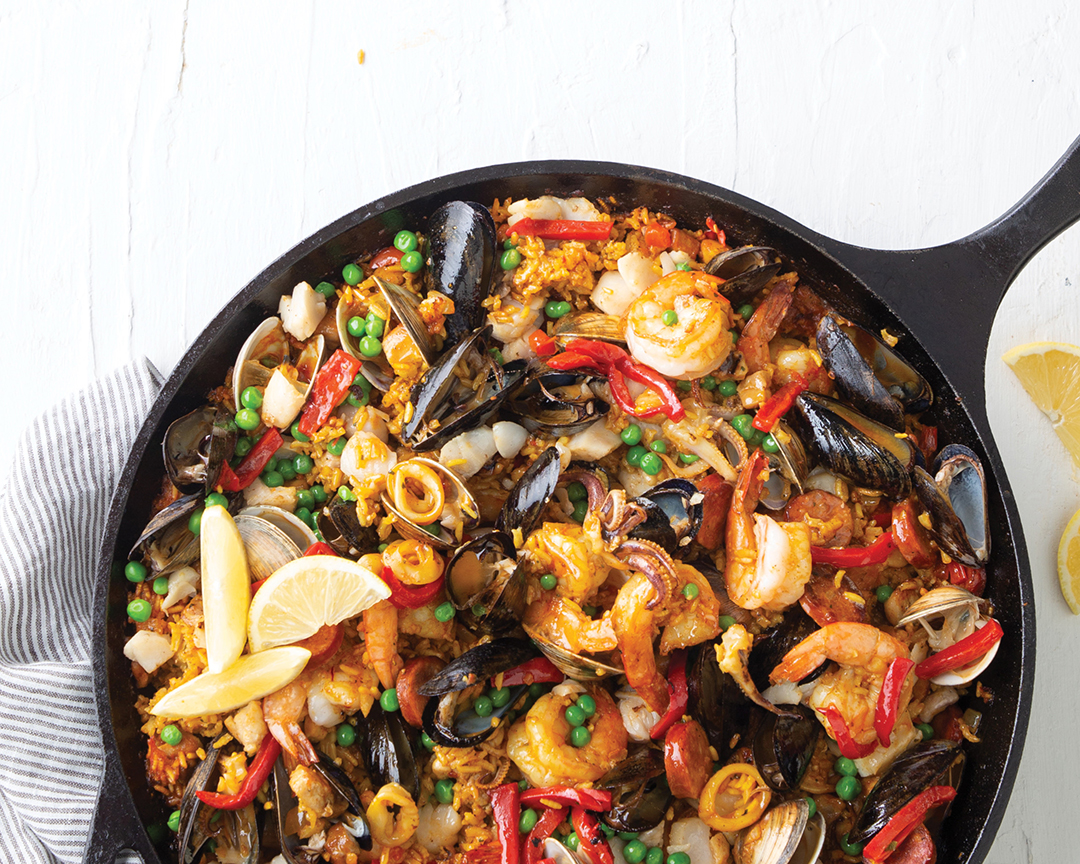
We may never know the exact origin of jambalaya. However, I’m sure Shakespeare would agree that “a jambalaya by any other name would taste as great.” I am sure you will love this Redfish Paella recipe shared with me by Chef Francisco Sterling.
- 1½ tablespoons plus ½ teaspoon kosher salt, divided
- 1 tablespoon ground black pepper
- 2½ pounds chicken thighs, boned and cut into ½-inch cubes
- ½ pound redfish, grouper, or other firm-fleshed fish fillets, cut into ½-inch cubes
- ½ pound squid, cleaned, cut into ½-inch rings and tentacles halved
- ½ pound boneless pork loin, cut into ½-inch cubes
- 16 medium fresh shrimp, peeled and deveined (tails left on)
- 6 cloves garlic, minced
- 2 tablespoons minced fresh parsley
- ½ teaspoon saffron threads
- ¾ cup olive oil, divided
- ½ pound andouille sausage, cut into ¼-inch slices
- 1 cup diced yellow onion (about 1 medium onion)
- ½ cup diced red bell pepper (about 1 medium bell pepper)
- 1 cup diced tomato (about 1 large tomato)
- 3 cups Spanish rice or Arborio short-grain rice
- 2 tablespoons smoked paprika
- 6 cups hot fish stock
- 24 small mussels, cleaned
- 12 small clams, cleaned
- ½ cup frozen peas
- ½ cup thinly sliced roasted red bell pepper
- Garnish: lemon wedges
- Preheat oven to 400°.
- Sprinkle 1½ tablespoons salt and black pepper all over chicken, fish, squid, pork loin, and shrimp.
- In the work bowl of a food processor, place garlic, parsley, saffron, and remaining ½ teaspoon salt; pulse until coarsely chopped.
- In a paella pan or a 14-inch cast-iron skillet, heat 6 tablespoons oil over medium-high heat. Add shrimp, and cook, stirring occasionally, for 2 to 3 minutes. (Do not cook completely.) Remove shrimp from pan, and set aside.
- In same pan, cook chicken over medium-high heat until browned but not fully cooked, 5 to 7 minutes. Remove chicken from pan, and add to shrimp.
- In same pan, cook pork loin and andouille over medium-high heat for 3 to 5 minutes; transfer to a platter, and set aside.
- In same pan, cook fish over medium-high heat for 2 to 3 minutes. Remove fish from pan, and set aside in a small bowl.
- In same pan, heat 2 tablespoons oil over medium-high heat. Add onion and diced bell pepper, and cook until wilted, 2 to 3 minutes. Stir in tomato, and cook for 1 to 2 minutes. Add rice and paprika, stirring to coat rice well with vegetable mixture. Add hot stock, and bring to a rolling boil over high heat. Add garlic mixture, and cook, stirring and rotating pan occasionally, for about 3 minutes. Add pork loin and andouille; stir well, and bring to a rolling boil. Cook until rice absorbs most of liquid, 5 to 7 minutes.
- Arrange fish, squid, chicken, shrimp, mussels, and clams on top of rice.
- Bake until rice is al dente, 15 to 20 minutes. Sprinkle with peas. Cover with foil, and let stand until rice is fully cooked, 10 to 12 minutes. Before serving, drizzle remaining ¼ cup oil over rice, and top with roasted bell pepper. Garnish with lemon wedges, if desired.