By: Chef John Folse
Growing up in St. James Parish in the 1950s, my siblings and I were not aware of the festivities of Mardi Gras 55 miles downriver in New Orleans. All we knew was that when Ash Wednesday rolled around, my mother had all eight of us lined up at the altar rail to get ashes. Thus began the holiest season of the year, when the church was draped in purple cloth to represent mourning and our Friday evenings were spent praying the Way of the Cross and attending adoration, which was truly a sacrifice for young boys who wanted to be in the swamp.
 From the Sunday pulpit, Father Lester Schexnayder emphasized Lent as a time of preparation, a kind of “spiritual spring cleaning.” We understood that meant preparing the heart and soul for Easter, but for us, it also meant preparing for the seasons ahead. It was time to repair river shrimp boxes and order cotton seed cake we’d use to catch Mississippi River shrimp in the weeks ahead.
We mended crawfish nets and painted the mirliton trellises. We picked Papere’s strawberries and helped plant the spring garden, which was always done during Holy Week but never on Good Friday. Our favorite tasks by far were collecting onion peels, clipping dandelions, and saving the water from boiled beets to dye the prettiest Easter eggs on River Road.
When Lent rolled around, we were required to fast from meat on Fridays. Like most families in our area, we lived off the land and ate what the swamp floor provided. Our refrigerator was stocked with an assortment of feathers, fins, and furs. During the early days of Lent, the crawfish and river shrimp were not yet running and the Mississippi River water was still too chilly to string trotlines. As it happened, St. James Parish was blessed with flocks of poule d’eau, or “water chicken,” during the first months of the year. Now, in a community that was 99 percent monetarily challenged, poule d’eau were plentiful and so were the mouths needing to be fed. Providentially, the local priests classified poule d’eau as fish (after all, they were fish-eating birds) and gave all of us a dispensation so we could eat poule d’eau stew on meatless Fridays. I guess, if “you are what you eat,” then poule d’eau truly is fish!
I’ve read that during the Middle Ages, cheese, butter, eggs, and fats were also prohibited during Lent. St. Thomas Aquinas explained that these items “afford greater pleasure as food [than fish].” Obviously, the angelic theologian never tasted Louisiana seafood gumbo or sauce piquante!
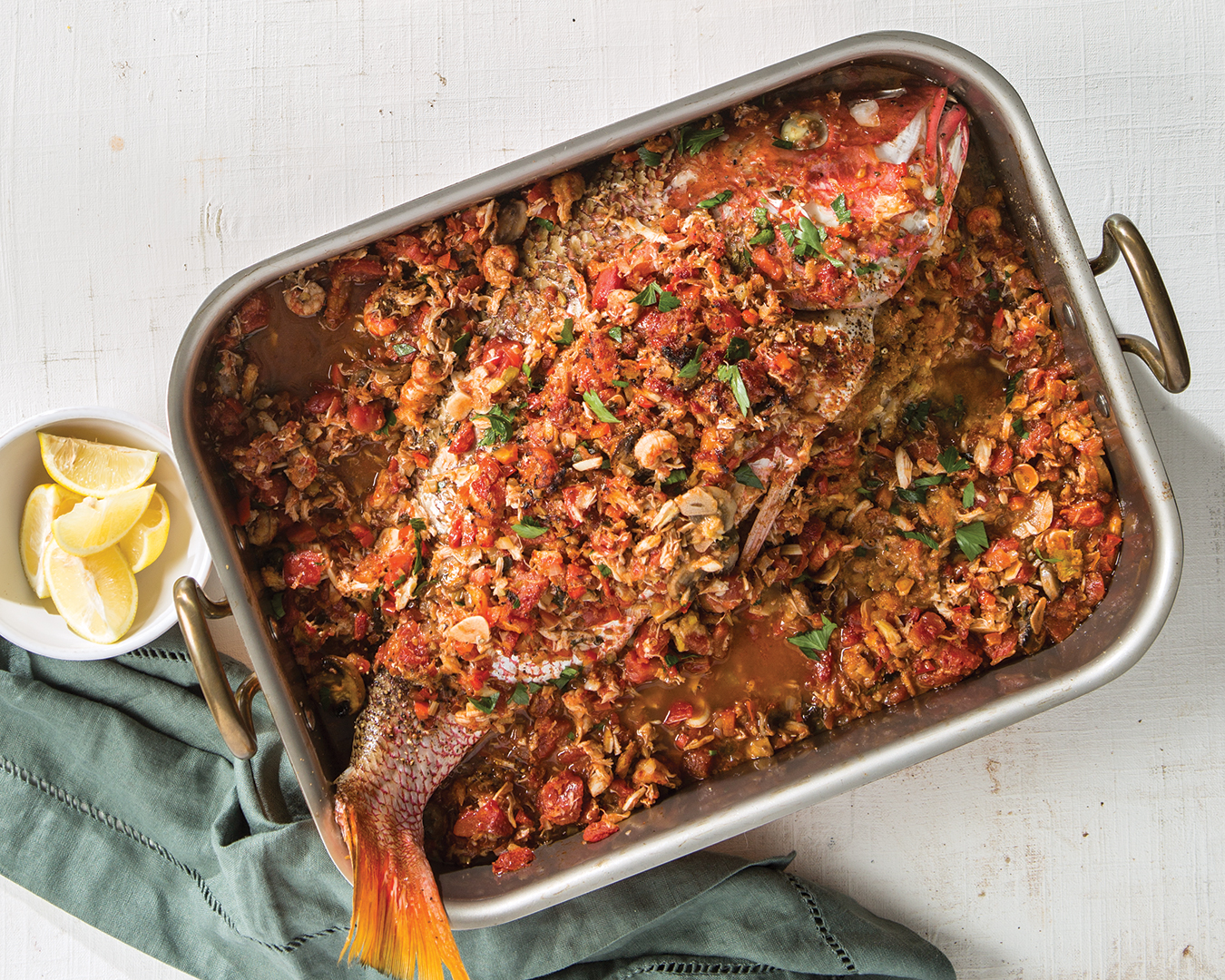
Because you might feel the same about poule d’eau, I’ve provided a great Snapper King Creole recipe to help in your abstinence from meat this season. You know, it really doesn’t seem that we Louisianans sacrifice much by substituting meat with seafood on fast days, but I guess, if it works for the church, it works for me, too!
- ½ cup unsalted butter
- ½ cup minced onion
- ½ cup minced celery
- ½ cup minced bell pepper
- ¼ cup minced garlic
- ½ cup chopped green onion
- ½ pound crawfish tails
- ½ pound lump crabmeat, picked free of shell
- 1 tablespoon lemon juice
- Creole seasoning, to taste
- 1½ cups Italian seasoned bread crumbs
- 1 (6- to 8-pound) whole red snapper, cleaned and rinsed
- Kosher salt, ground black pepper, and granulated garlic, to taste
- 1 tablespoon paprika
- Creole Sauce (recipe follows)
- Garnish: chopped fresh parsley, lemon wedges
- ½ cup olive oil
- 1 cup minced onion
- 1 cup minced celery
- 1 cup minced red bell pepper
- ½ cup thinly sliced garlic
- 1 cup sliced button mushrooms
- 1 (28-ounce) can diced tomatoes
- 1 (10-ounce) can diced tomatoes with green chiles
- 1 (8-ounce) can tomato sauce
- 2 tablespoons chopped fresh oregano
- 2 tablespoons chopped fresh basil
- 2 bay leaves
- ¾ cup pinot noir or other dry red wine
- ½ pound crawfish tails, drained
- ½ pound lump crabmeat, picked free of shell
- Kosher salt and cayenne pepper, to taste
- Preheat oven to 350°.
- In a large saucepan, melt butter over medium-high heat. Add minced onion, celery, bell pepper, and minced garlic; cook until vegetables are softened, 2 to 3 minutes. Add green onion, and cook until softened. Add crawfish and crab, and cook until heated through, 3 to 4 minutes. Stir in lemon juice. Season to taste with Creole seasoning, and add just enough bread crumbs to achieve a moist stuffing consistency. Set aside.
- Place fish in a large roasting pan, and season with salt, black pepper, and granulated garlic. Stuff fish cavity with onion mixture, and sprinkle with paprika. Pour Creole Sauce over fish.
- Bake until an instant-read thermometer inserted in stuffing registers 130° and fish flakes easily, 1 to 1½ hours.
- Using 2 large spatulas, transfer fish to a large serving platter. Reserve sauce from roasting pan. Using a boning knife, slowly remove fillet from top of fish; discard any bones. Remove fillet from bottom of fish. Cut fillets into 4 to 6 servings. Divide fish among serving plates, and top with reserved sauce. Garnish with parsley and lemon, if desired.
- In a large Dutch oven, heat oil over medium-high heat. Add onion, celery, bell pepper, and garlic; cook until vegetables are softened, 3 to 5 minutes. Add mushrooms, and cook for 1 to 2 minutes. Stir in all diced tomatoes, tomato sauce, oregano, basil, bay leaves, and wine. Bring to a boil over high heat; reduce heat, and simmer, stirring occasionally, for 15 to 20 minutes.
- Add crawfish and crab, and cook, stirring gently, until heated through, 2 to 3 minutes. Season to taste with salt and cayenne.