By Chef John D. Folse
I’m sure you’ve heard the phrase “don’t judge a book by its cover.” I implore you not to judge a dish by its ingredients either. I learned this myself in August 2017 when I finally embarked on a trip to the land of my ancestors, Germany.
Within an hour of clearing customs and renting a car at Frankfurt International Airport, I was strolling the streets of Schlierbach, Germany, where my seventh great-grandfather, Hans Peter Voltz, was born around 1618. Just as my ancestors had crossed Germany and France in search of a new homeland in Louisiana, so did I crisscross Germany and France not only in search of my German roots but in search of Germany’s tapestry of flavor as well.
I traveled from Schlierbach to Kaiserslautern to Ramstein and the Mosel Valley into the Black Forest and Freiburg and across the Rhine to travel the Alsace Wine Route. While navigating the Catholic Archives in Speyer, Mainz, Darmstadt, and Freiburg, I also maneuvered my way through restaurant menus, searching for food traditions that crossed the Atlantic to Louisiana. There were many memorable meals of wiener schnitzel, sauerbraten, whole roasted fish, käsespätzle, spargel (or white asparagus), and the best of the wurst—all accompanied by Mosel and Alsatian wines as well as local brews. Little did I know that the best was yet to come.
My last evening was spent in the shadow of Strasbourg Cathedral with dinner at Maison Kammerzell. This temple of gastronomy awed me with the traditional Alsatian-Germanic dish choucroute garnie. However, Chef Guy-Pierre Baumann provided an interesting twist to this classic.
I grew up eating choucroute garnie along the German Coast in St. James Parish. After harvesting cabbages from Papere’s garden, Mamere would shred the cruciferous fragments into a 5-gallon crock, add salt, and repeat the method several times, completing the process with dried juniper berries. The mixture was left to ferment for 4 to 5 weeks. Then she cooked the soured cabbage with potatoes and smoked meats—bacon, andouille, smoked sausage, ham, and pork hocks—a hearty dish to feed hungry children, to be sure.
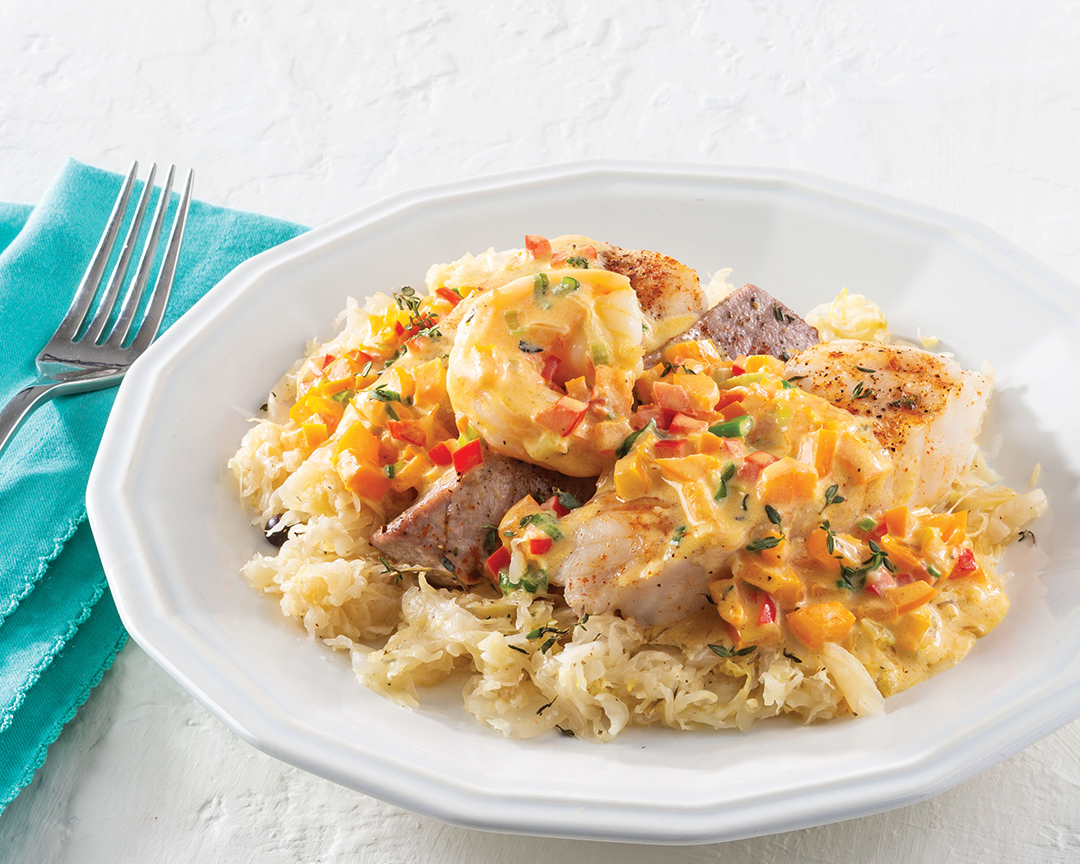
Chef Baumann’s reinterpretation of this favorite dish had all the markings of traditional choucroute garnie but with what I considered a Louisiana addition: a trio of fresh fish. I thought about this for a moment. If Louisiana is a melting pot of cultures and cuisines, I could borrow from Chef Baumann to revolutionize the River Road classic. Thus, my recipe for Choucroute du Golfe was born. Remember, don’t prejudge the worth of a dish by its ingredients or outward appearance; rather, indulge in the decadence of a new masterpiece! Bon appétit!
Chef John D. Folse is an entrepreneur with interests ranging from restaurant development to food manufacturing, catering to culinary education. Similar recipes can be found in The Encyclopedia of Cajun & Creole Cuisine (Chef John Folse & Company).
- ½ cup bacon drippings
- 1 cup chopped yellow onion
- ¼ cup minced garlic
- 2¾ cups dry white wine, divided
- 2 tablespoons dried juniper berries
- 1 tablespoon plus 2¾ teaspoons kosher salt, divided
- 1¾ teaspoons ground black pepper, divided
- 1 teaspoon ground cumin
- 1 dried bay leaf
- 1 sprig fresh thyme
- 2 (32-ounce) jars sauerkraut, rinsed twice in water and drained thoroughly
- ½ cup unsalted butter
- ½ cup minced green onion
- ¼ cup minced red bell pepper
- ¼ cup minced yellow bell pepper
- 1 cup heavy whipping cream
- 8 jumbo fresh shrimp, peeled and deveined (tails left on)
- ¾ teaspoon granulated garlic, divided
- 1 (1-pound) red snapper fillet, cut into 8 pieces
- 1 (1-pound) tuna fillet, cut into 8 pieces
- 1 (1-pound) grouper fillet, cut into 8 pieces
- 1 tablespoon paprika
- Garnish: fresh thyme
- In a large cast-iron Dutch oven, heat drippings over medium-high heat. Add yellow onion and minced garlic; cook, stirring frequently, until softened, 3 to 5 minutes. Add 2 cups wine, juniper berries, 1 tablespoon salt, 1 teaspoon black pepper, cumin, bay leaf, and thyme; cook for 3 to 5 minutes. Add sauerkraut, stirring until well combined. Bring mixture to a rolling boil; reduce heat, cover, and simmer, stirring occasionally, for 30 to 40 minutes. Remove from heat, and discard bay leaf and thyme sprig.
- Preheat oven to 375°.
- Meanwhile, in a large skillet, melt butter over medium-high heat. Add green onion and bell peppers; cook until softened, 2 to 3 minutes. Add remaining ¾ cup wine; bring to a rolling boil, and cook until reduced to ¼ cup, about 2½ minutes. Add cream; return to a rolling boil, and add shrimp. Cook until shrimp are pink and firm and sauce is slightly thickened, 2 to 3 minutes. Stir in ¾ teaspoon salt, ¼ teaspoon black pepper, and ¼ teaspoon granulated garlic.
- Meanwhile, rinse fish fillets well, and check for small bones; pat dry. Place fillets on a baking sheet, and spray fillets and baking sheet with cooking spray. Sprinkle fillets with remaining 2 teaspoons salt, remaining ½ teaspoon granulated garlic, and remaining ½ teaspoon black pepper. Sprinkle with paprika.
- Bake for 7 minutes or to desired degree of doneness for tuna. Remove tuna, and transfer to a serving platter. Bake snapper and grouper until fish flakes easily, about 3 minutes more. (Do not overcook.) Divide sauerkraut mixture, fish, and shrimp among serving bowls; serve with sauce. Garnish with fresh thyme, if desired.