Story by Chef John D. Folse and Michaela D. York
Recipe by Chef John D. Folse
Photography by Jim Bathie
Food styling by Kathleen Kanen
Styling by Maghan Armstrong
September is a month of transition. Kids are back in school, the massive heat of summer has somewhat subsided, and everyone prays for bountiful harvests of sweet potatoes, wild game, and sugar. Of course, the Blessing of the Fleet in Morgan City ensures a plentiful harvest of shrimp. Everyone prays for no hurricanes, safety for all families, and no destruction of property, especially hunting camps. It’s officially harvest season throughout Louisiana—land, gulf, and marsh!
I love driving the highways and byways this time of year. Honestly, it’s hard to pass those large bundles of mustard greens, collards, and turnips. I always stop for the golden jewels of sweet potatoes and crookneck squash that populate the state. Later in the harvest season, I collect bags of pecans, persimmons, mandarins, and oranges. This is also the season to harvest sugarcane. Though I love the phrase “how sweet it is,” I can assure you there was nothing sweet about harvesting cane when I was a teenager.
I grew up in the sugarcane fields along River Road on the West Bank. My daddy was the manager of St. James Sugar Co-op, which meant that all six of his sons had a job at the sugarhouse come harvest season. We remember the task of wielding cane knives with precision as we cut the stalks and tried to avoid reaping the sharp-as-a-blade cane leaves.
This is also the season when hunters prepare their guns, camps, and cast-iron pots. My brothers never missed out on hunting the small migratory birds such as doves, rails, and gallinules this time of year. But the most sought-after birds were teal ducks, which are harvested only in September. These blue- or green-winged teal ducks, with cinnamon-colored streaks on the head, make for a fantastic meal. With a bag limit of 18 birds, you can get your fill. We often caught and enjoyed many delicious teal recipes at the Sugah Shack (a.k.a the hunting camp). Years later, a friend of mine, Chip Veillon, gifted me with his favorite teal duck recipe.
Chef John D. Folse is an entrepreneur with interests ranging from restaurant development to food manufacturing, catering to culinary education. Similar recipes can be found in After the Hunt (Chef John Folse & Company), coauthored by Michaela D. York.
- 1 container Guidry’s Creole Seasoning® (onion, celery, bell pepper, garlic)*
- ½ cup green onion sausage or ground pork
- Creole seasoning to taste
- 12 teal ducks, dressed
- ½ cup vegetable oil
- 1 cup red wine
- 3 to 4 cups chicken stock
- 6 cups mashed sweet potatoes
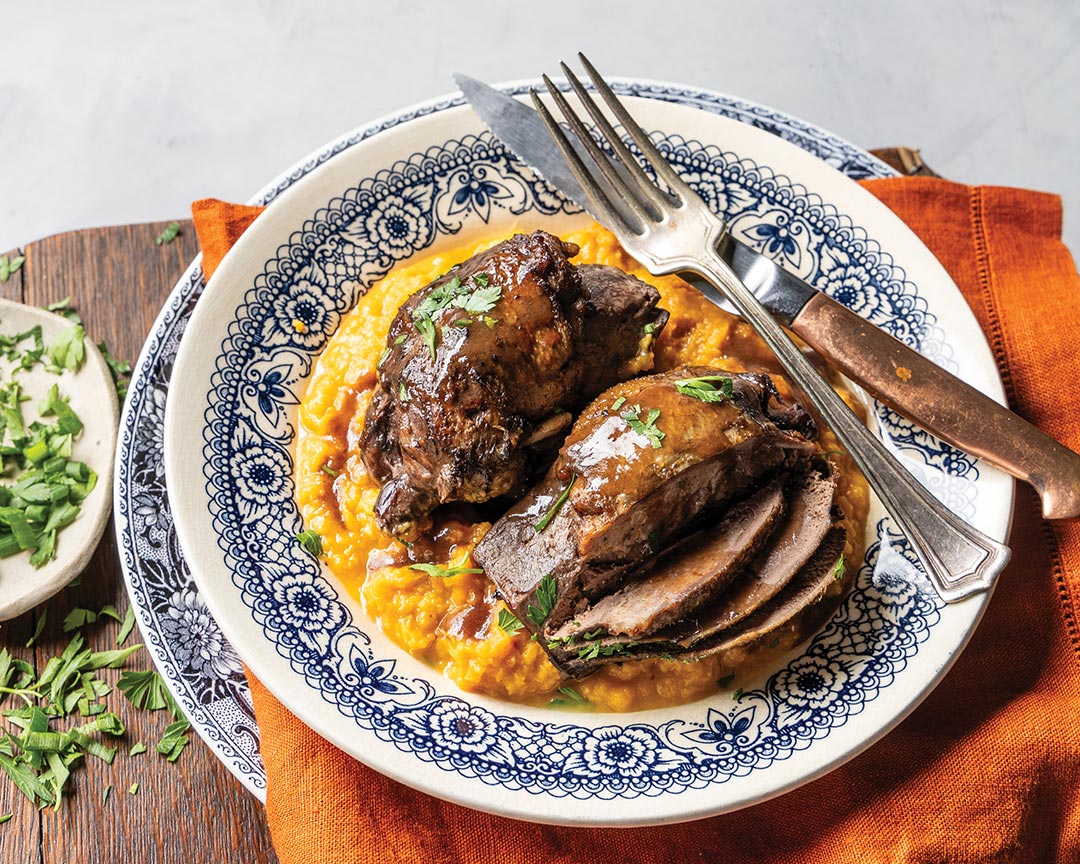
- Garnish: chopped fresh parsley
- In a food processor or blender, purée the seasoning blend. Add sausage or ground pork and continue to blend. Add Creole seasoning to taste. Mixture should be a smooth paste, thin enough to pass through a large syringe, but not liquid. Set aside.
- Season teal duck inside and out with Creole seasoning. Starting from the back, run a sharp knife along each side of the sternum, being careful not to break the skin on the front of the breast.
- Fill syringe with puréed mixture and inject into each side of breast until it “puffs up.”
- In a large pot, heat vegetable oil over medium-high heat and then place teal, breast side up, in pan.
- Brown for 7 to 8 minutes before rotating and browning other side of breast an additional 7 to 8 minutes. Deglaze the pan with wine and allow to steam 6 to 8 minutes.
- Add enough chicken stock to cover birds three-quarters of the way. Bring to a boil and then cover and reduce to simmer. Cook 2 to 3 hours or until backbones start to become defined.
- Add water or chicken stock as necessary to keep pot from drying out. Remove from heat and serve hot with pan juices and mashed sweet potatoes. Garnish with chopped parsley, if desired.
Chip suggests a feeding syringe for getting the seasoning mixture into the breast (check at medical or farm supply stores). A pastry bag would work in a pinch, though.