Story by Daniel Schumacher | Recipes and Photography Reprinted with Permisson from Kwéyòl / Creole: Recipes, Stories and Tings from a St. Lucian Chef’s Journey by Nina Compton with Osayi Endolyn Copyright © 2025. Photographs by Brittany Conerly and L. Kasimu Harris | Illustrations by Fiona Compton Published by Clarkson Potter, A Division of Penguin Random House, LLC.
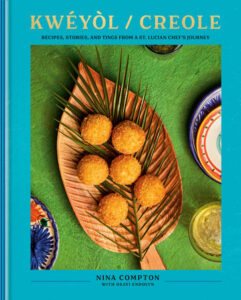
It was during her time filming season 11 of Top Chef that Chef Nina Compton had her eyes opened to New Orleans. Having grown up in the Caribbean on St. Lucia, Nina felt a connection to the multicultural makeup of the city and how that all plays out in the culinary scene. She started working on a cookbook around that time, but she put that on the back burner when she and her husband, Larry Miller, opened Compère Lapin in New Orleans’ Central Business District in 2015.
All across the menu, diners who were often quite familiar with the New Orleans Creole mindset were treated to Nina’s interpretation of island Creole flavors and presentations. Saltfish fritters, cow heel soup, and curried goat with pillowy sweet potato gnocchi weren’t the sort of things showing up on many Crescent City menus back then, but Nina was wholeheartedly embraced by the city and went on to open Bywater American Bistro (now, simply, BABs) in 2018 and then Nina’s Creole Cottage in 2023.
In 2020, amid the uncertainties of the COVID-19 pandemic, Nina felt it was time to return to the cookbook project. With the help of writer Osayi Endolyn, Nina ultimately published Kwéyòl / Creole: Recipes, Stories, and Tings from a St. Lucian Chef ’s Journey earlier this year. For diners who have fallen in love with Nina’s cooking, the book is a godsend, and for home cooks who haven’t yet visited Compère Lapin or Nina’s other restaurants, it is an invaluable glimpse into the ways Creole culture has manifested throughout the Caribbean (and in the Crescent City).
Kwéyòl / Creole is broken up into four major sections of Nina’s life, starting in St. Lucia and then Jamaica, Miami, and finally New Orleans. Each section builds on the previous, and readers get a firsthand look at the similarities and differences throughout the Creole-Caribbean diaspora. In the book’s forward, New Orleanian writer Lolis Eric Elie writes, “This book is an immersive experience. It is a determined effort to bring you as close to the people and places of these Creole worlds as paper and ink will allow.”
The Island Pantry
At this point, many cookbooks begin with a section explaining various pantry items and techniques that will come in handy for folks who plan to cook their way through the book. With Kwéyòl / Creole, this section includes a breakdown of all things coconut along with Nina’s preferred kosher salt (Diamond Crystal) but also introduces specific ingredients she grew up using that are less commonly found in many areas of the US.
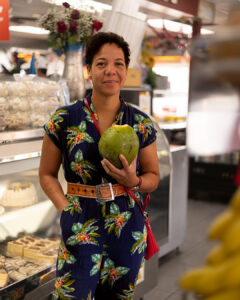
From saltfish and browning, made from deeply caramelized sugar and water, to cassareep (a rich, spiced glaze made from reduced cassava root juice) and green fig (green unripe bananas), Nina adds some context to the flavors she grew up with and experienced throughout her journeys. On choosing papayas, Nina says, “Here there are two varieties: the very small ones and the large ones. I recommend getting the larger ones. The flesh when you touch it should be firm but not hard. You’ll see a slight color change; it will be more like yellow-orange, but if it’s very green it’s not going to be ready.”
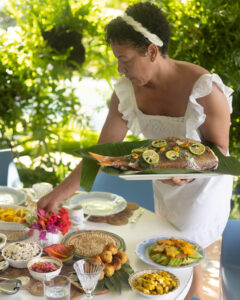
“Being a chef in New Orleans is the greatest gift that anybody can get because you have so many people who are excited about food. It makes my job much easier because people appreciate it. With so many traditions and so much culture and preservation of the people that came before us was really a big thing as well.” —NINA COMPTON
Crescent City Connections
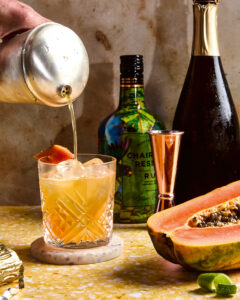
Passion Fruit Punch
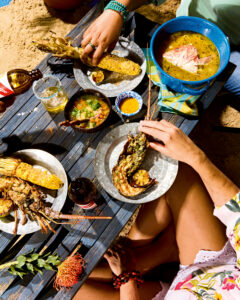
This is the kind of drink that instantly transports me to the Caribbean. I can immediately feel the sunset on my skin on Negril Beach. The cliffside has unobstructed views of the ocean, and it’s the best place to watch the day slip away. I drink rum when I’m in the Caribbean; it gives me a sense of place.
- 1 small ripe papaya
- Ice, for chilling and for serving
- 4 ounces white rum (such as Bounty)
- 4 ounces dark rum (such as Chairman’s or Appleton)
- 4 ounces passion fruit puree
- 2 ounces agave syrup
- 2 ounces fresh lime juice (reserve the peel for garnish)
- 2 ounces champagne (or dry sparkling white wine)
- 4 tablespoons sugar
- 4 strips of lime peel
- Using a paring knife, slice the papaya in half. Use a spoon to seed the papaya. Cut one-third of the papaya into four 1-inch wedges for garnish and set aside.
- Chop the rest of the papaya and place the pieces in a cocktail shaker. Use a muddler until the papaya is mashed into a pulp, 10 to 20 seconds.
- Fill the cocktail shaker with ice. Add the white rum, dark rum, passion fruit puree, agave syrup, and lime juice. Shake well. Add several ice cubes to your rocks glasses. Strain the mix into the glasses.
- Add the champagne as a float; each glass gets ½ ounce.
- Prepare your garnish: Use a paring knife to make a small slit in the tip of the papaya wedges. Coat them evenly in the sugar and place them on the glass rims, then add a lime peel to each glass. Serve immediately.
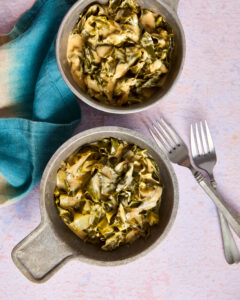
Coconut-Braised Collard Greens
- 2 tablespoons coconut oil
- 1 large Spanish onion, thinly sliced
- 1 teaspoon cayenne pepper
- 1 teaspoon smoked paprika
- 3 bunches of collard greens, tough stem ends trimmed, stems and leaves sliced ½ inch wide
- 2 tablespoons kosher salt
- 2 (14-ounce) cans coconut milk
- In a large saucepan on medium heat, add the coconut oil and sweat the onions, stirring occasionally, until translucent, about 3 minutes.
- Add the cayenne pepper and paprika. Stir to evenly distribute, and cook until the spices are well incorporated, about 3 more minutes.
- Add the collards and salt; cook, stirring occasionally, until the greens soften, 5 to 10 minutes. Add the coconut milk, cover, and reduce the heat to low. Simmer until the greens are tender and the sauce is creamy, about 45 minutes. Serve immediately.
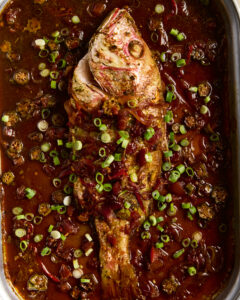
Brown Stew Snapper
This is a Jamaican dish you’ll find on pretty much any menu whether you’re in-country or in the diaspora. The fish is fried, then finished in the oven or on the stovetop, then covered with the brown stew. Browning is a burnt sugar and water mix that we use in our cooking throughout the Caribbean to add color to dishes. You can replace the snapper with swordfish, salmon, or tuna steak.
- 1 (1- to 1½-pound) whole red snapper, scaled and gutted
- 3 tablespoons Green Seasoning (recipe follows)
- 1½ tablespoons kosher salt
- 1 teaspoon minced garlic
- ½ teaspoon grated fresh ginger
- ½ teaspoon thyme leaves
- ½ teaspoon ground white pepper
- 1 lemon, zested and juiced
- Canola oil, for frying
- 2 cups rice flour
- 1 medium Spanish onion, thinly sliced
- 1 red bell pepper, thinly sliced
- 1 teaspoon minced Scotch bonnet pepper
- 1 teaspoon thyme leaves
- 1 garlic clove, minced
- ½ teaspoon Green Seasoning (recipe follows)
- 1 fresh bay leaf
- 3 medium tomatoes, cut into ¼-inch dice
- ¼ cup sliced okra (¼-inch rounds)
- ¼ cup browning
- 2 cups Ginger Lemongrass Fumet or vegetable stock
- 2 scallions, thinly sliced
- Serve with Coconut Rice and Peas
- Prepare the snapper: Rinse the fish. Drain and pat dry with paper towels or a clean towel. Using a paring knife, gently but firmly score the fish from the gill to the tail on both sides, along the belly’s surface in crosshatches, about 2 inches apart. You want to go beneath the skin surface, but not so deep that you cut through the fish. When you’re done, it should look like a stretched grid across the fish’s surface.
- Place the fish in a large bowl or on a sheet pan, then season with the green seasoning, salt, garlic, ginger, thyme, white pepper, and lemon juice and zest. Use your hands to gently and thoroughly coat the fish with the seasoning on the inside and out. Chill in the refrigerator for at least 30 minutes. Cover the fish if you marinate it overnight.
- When you’re ready to cook the fish, in a large skillet, add canola oil to a depth of 2 inches (about 1 cup) and heat over medium to 350°; check using an instant-read thermometer.
- Once the oil is ready, spread out the rice flour on a wide, flat plate. Remove the fish from the refrigerator and lightly shake off any excess marinade. Evenly dust the exterior with the rice flour.
- Immediately add the coated fish to the skillet. Cook each side until golden brown, 3 to 4 minutes per side. Transfer the fish to a plate or cooling rack.
- Make the brown stew: Drain most of the oil from the skillet, leaving about 3 tablespoons behind, or add the same amount of oil to a wide saucepan. Add the onion, bell pepper, Scotch bonnet, thyme, garlic, green seasoning, and bay leaf to the skillet or saucepan. Sauté over medium heat, stirring frequently to avoid any burns, until the onions are tender, about 2 minutes. Add the tomatoes, okra, and browning. Continue to stir. Add the ginger lemongrass fumet and let the stew simmer until the vegetables soften and the sauce starts to thicken, about 5 minutes. Add the fish to the sauce and spoon it over the fish. Remove bay leaf and discard.
- Top the stew and fish with scallions and enjoy immediately with Coconut Rice and Peas.
- 1½ cups extra-virgin olive oil
- 1 bunch of scallions, roots trimmed, sliced into 1-inch pieces
- ½ cup roughly chopped cilantro
- ½ cup roughly chopped flat-leaf parsley
- 1 small green bell pepper, chopped
- 2 tablespoons roughly chopped fresh ginger
- ½ teaspoon chopped Scotch bonnet pepper
- 1½ teaspoons kosher salt
- In a blender, add the olive oil, scallions, cilantro, parsley, bell pepper, ginger, Scotch bonnet, and salt. Puree until smooth, about 2 minutes. Transfer to an airtight container; it will keep, refrigerated, for up to 2 weeks.