Story and recipes by Marcelle Bienvenu
Photography by Kyle Carpenter
Food styling by Vanessa Rocchio
Styling by Maggie Ratliff Hill
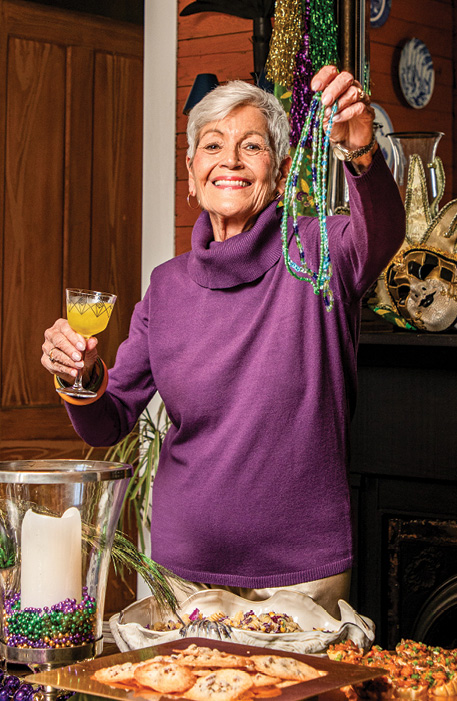 The Carnival season of my childhood in the late 1940s and early 1950s was rather lackluster. In my small but historic town of St. Martinville, we didn’t have king cakes or parades. There was a ball sponsored by the local Rotary Club, but, of course, it was for adults only.
Some adventuresome youngsters—my siblings and I were not in that group—were allowed to clothespin playing cards to their bicycle spokes to create a slapping noise as they cruised around the downtown area. These kids on their bikes, armed with bars of soap, marked up the showcase windows of the local general stores, banks, and barbershops. (I remember witnessing store owners on Ash Wednesday washing their windows to get rid of the mess and probably cursing silently.) At the time, some children wore costumes of oversize pants stuffed with straw and shouted, “Mardi Gras, chickle-le-paw!” The children had twisted the Creole words “tchou qu’a li paille,” which means “straw-stuffed bottoms.”
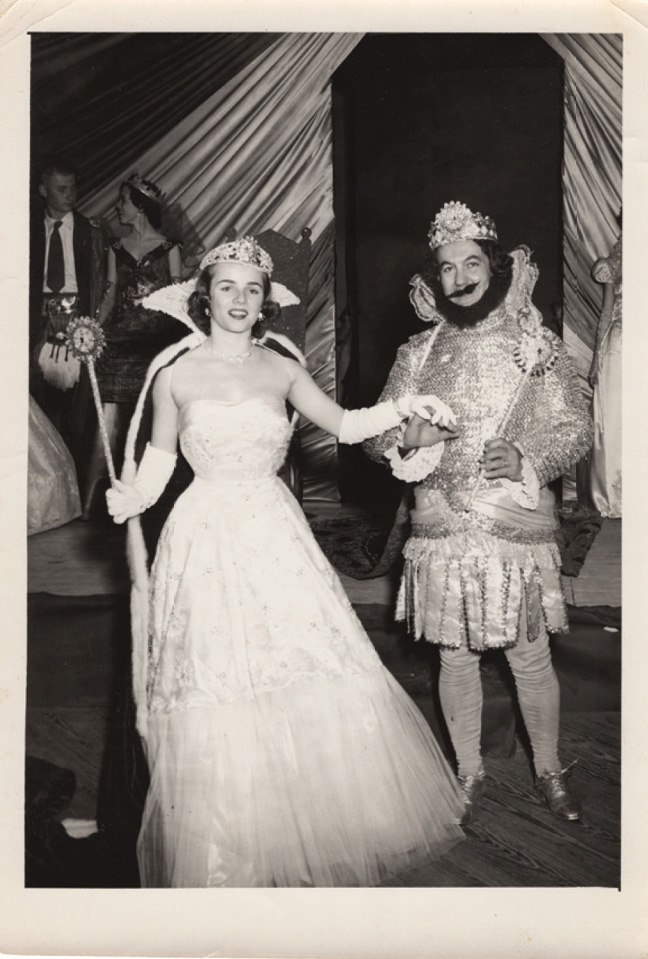 As I moved on to my teen years, the Rotary Ball began staging marvelous tableaux. Youngsters and high school students were often part of the show. One year the theme was Madame Butterfly, and several of my schoolmates and I were dressed in colorful kimonos tied up with traditional obi that were handmade by local seamstresses or mothers to act as pages to the queen. One year “Come to the Circus” was the production, and I dangled on a trapeze, thankfully not too far off the ground.
During my teenage years, my parents began allowing me to go in groups to Lafayette for Mardi Gras Day. My brother who was at USL (now University of Louisiana at Lafayette) was put in charge of me and a couple of my friends. He showed us around to the local college hangouts: the Library (a beer bar), the Keg (where one could dance and drink), and the Bulldog Inn (if we needed a poorboy). By midafternoon, we gathered on Jefferson Street for a parade that, at the time, still had horseback riders clad in beautiful cowboy outfits. Then it was a race to get to our ride back to St. Martinville before dark.
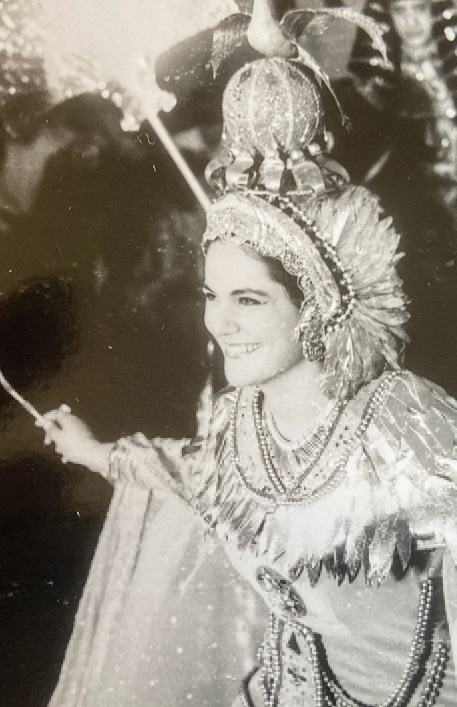
While in college, I was invited to be Queen of the Rotary Ball. I was beyond thrilled. There was a queen’s luncheon and a queen’s tea party. And that meant a whole new queen’s wardrobe. My mother and her friends were busy at their sewing machines for weeks.
It wasn’t until I was working at the Dixie Roto Magazine at the Times-Picayune in New Orleans in 1969 that I got the assignment to go cover the courir de Mardi Gras. In and around the prairie towns of Mamou, Eunice, and Church Point, northwest of Lafayette, the local folks participate in the “running of Mardi Gras.” This is unlike any other Mardi Gras celebration in the state and, well, probably in the world. Although it does share the processional nature of a parade, as a moving celebration, its roots are firmly in the medieval ceremonial begging celebration, which featured a performance in anticipation of a donation, kind of like singing for your supper.
Mardi Gras begins early in the day when the riders gather on horseback at a predesignated area, with a contingency of wagons to carry the musicians and their donations along the way. The route the riders take varies from year to year and is kept secret until the morning of the courir. At that time, the capitaine (easily recognized by his voluminous cape), who carries a flag, announces the route. His followers, attired in ragtag costumes, often wearing conical hats and always a mask, are ready for the ride through the countryside, going from house to house, begging for chickens, rice, sausage, flour, and oil, the ingredients with which to make a communal gumbo at the end of the day. The captain adheres to the tradition of raising a white flag to ask permission for his riders to enter the yard. If permission is granted, the captain lowers his flag and the riders are free to charge the house. There, they dismount to sing and dance for the household. After an appropriate time, the head of the household may bring out a live chicken, which he throws into the air for the celebrants to catch on the run. Then the group continues on to the next stop. With any luck, by the end of the day, the wagons are filled with everything that is needed for the gumbo.
 After following the rigorous ride, many participants headed to Mamou, the home of Fred’s Lounge, where, on any given Saturday, one can enjoy a cold beer accompanied by spicy boudin for breakfast while listening to the best in Cajun music. I am pleased to report it is still in existence.
When the riders get back to town in the afternoon, the streets are packed with people waiting to make a big gumbo served with potato salad, and, of course, there is a big fais-dodo that goes into the evening.
When I moved to the French Quarter in the 1970s, a neighbor invited me to a king cake party. I arrived as the cake was being sliced, and everyone got a piece. Then I learned that if you had the slice with the plastic baby in it, you were to be the host for the next king cake gathering. It was a great way to meet and make new friends.
My celebration of Carnival seasons in the Big Easy included everything from before, during, and after-parade parties to elegant balls and royalty luncheons at Antoine’s to brunches celebrated in the courtyard of my French Quarter apartment. I have fond memories about these fun times. Each year when Carnival season rolls around, I take out my chest of memorabilia to admire the beautiful silver and gold royal doubloons I was given as souvenirs. I also have a great collection of king cake babies and other souvenirs like pins, earrings, and bracelets that were so generously given to me at the balls.
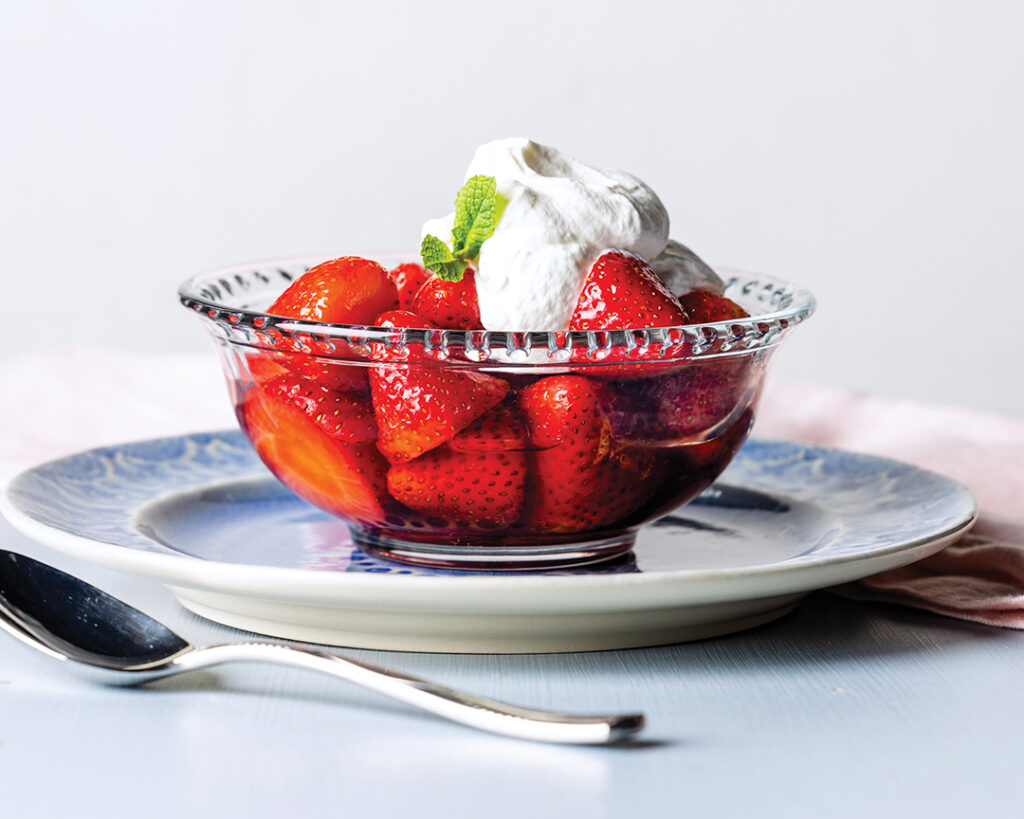
But perhaps one of my favorite memories was being invited to sit in the royalty bleachers on Mardi Gras Day for the queen’s parade in Lafayette a few years ago. My hosts welcomed me with a flute of perfectly chilled Perrier-Jouët Belle Époque (my favorite, and no Bloody Mary in a styrofoam cup in sight). Then they opened their food basket that contained a velvety-smooth chicken pâté, toasted croutons, small kabobs of medium-rare fillet of beef lightly brushed with horseradish-sour cream sauce, mini cucumber sandwiches, followed by strawberries tossed with brown sugar and sweet cream. Simply delicious! Laissez les bon temps rouler! Let the good times roll. And the high-spirited good times will roll full speed until midnight; then at the magic stroke of 12, by law and by custom, celebrating must end, for Lent has begun.
Say Yes to the Dress
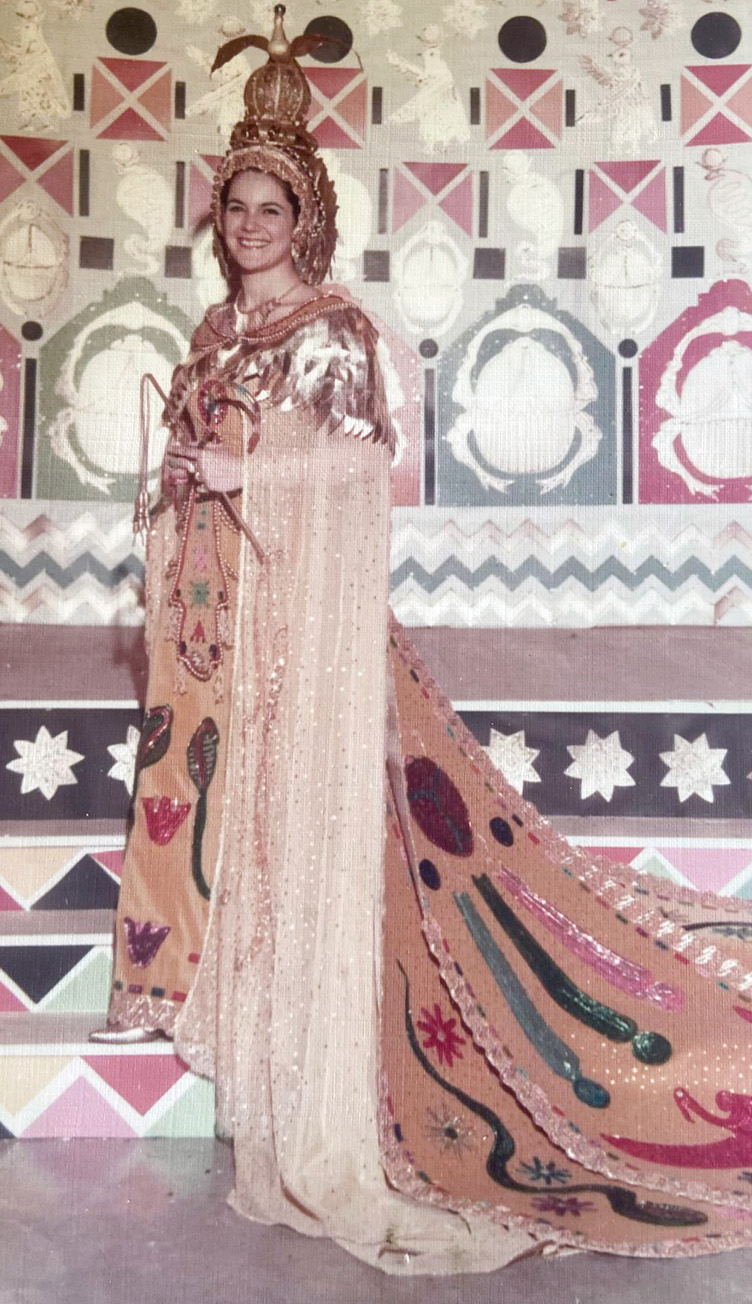 I must tell you about my evening gown for the King’s Reception. My mother, known for her seamstress abilities, and I drove to New Orleans at the crack of dawn a few weeks before the event to look at a gown in the showcase of D.H. Holmes. We made notes, drew front and side views. (No iPhones back then.) We couldn’t see the back! Then we drove back toward St. Martinville to go to a popular fabric store in Lafayette to purchase our sewing needs. I watched the clerk roll out yards of peau de soie, a smooth, finely ribbed satin fabric of silk, and crepe de chine, which has a silky-smooth feel, fluid drape, and a grainy texture, for the two-piece ensemble.