Story by Kaitlyn Shehee | Photography by Jim Bathie | Recipe Development by Jan Jacks Potter | Food Styling by Kathleen Kanen
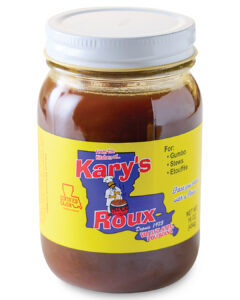
In Ville Platte, tradition is stirred, bottled, and shared. What began as a kitchen staple in a restaurant has become a pantry essential for many across Louisiana, a legacy born of time, patience, and the kind of consistency that keeps generations gathering around the gumbo pot.
The story of Kary’s Roux began in 1950, when the family patriarch, Archange Lafleur, opened Pig Stand Bar-B-Q, a beloved local restaurant that quickly became known for its barbecue and hospitality. “My grandfather ran the Pig Stand from 1950 until 1980,” says Ross Lafleur, the founder’s grandson and Kary’s current owner. “During that time, they began bottling their barbecue sauce for customers who wanted to bring a little of that Pig Stand flavor home.” Those jars of Pig Stand Barbecue Sauce soon found their way onto grocery shelves and, unknowingly, paved the way for something even more enduring.
In the 1970s, Ross’ grandfather had another idea, one that spoke to the rhythm of kitchens in Louisiana. Customers often asked if they could buy a bit of his roux, the browned flour-and-oil base that anchors Louisiana’s signature dishes like gumbo, étouffée, and sauce piquante. So, he turned to his son, Kary, with a proposition: finish college, come home, and help make a business born out of bottling good-quality roux.
Kary did just that. In 1975, Kary’s Roux was born, named after Kary himself, with the same care and precision that defined his father’s cooking. Five years later, after his father’s passing, Kary refined the process and expanded the product line while keeping the same two-ingredient foundation: flour and oil, cooked slow in cast-iron kettles until the color was just right.
“We still cook by eye,” says Ross. “There’s no fancy equipment or color meter. Just generations of knowing when it’s ready.” When the roux reaches its deep mahogany shade, it’s poured into cooling troughs before being jarred, labeled, and shipped off to kitchens across the South and beyond.
Over the years, the roux offerings expanded: from the original dark roux that’s best for heartier dishes like gumbo and fricassee to an updated lighter roux that sings when used in delicate dishes like crawfish étouffée, and later, a dry roux with no oil for those seeking a no-fat option. “That one came from a family friend who wanted a healthier alternative,” Ross explains. “It ended up being a hit because it dissolves faster in water and is easier to digest while keeping the same deep flavor.”
What started with one cast-iron kettle and one product has grown into a full pantry of Cajun essentials, each built on the same philosophy: authentic flavor made easy. The guiding principle has always been to help people put delicious food on the table, even if they don’t have the time to make roux from scratch. Because as any Louisiana cook knows, roux can be unforgiving. One wrong move, and all that hard work can get scorched in seconds. “That’s really where it started—making good food more accessible,” he says. “People love the taste of homemade gumbo, but they don’t always have the time or confidence to make a roux. With ours, they know exactly what they’re getting every time.”
Consistency is key, not just in the product but also in the values that drive the company. Though Kary’s Roux has expanded distribution into new markets, especially Texas, where many Louisiana transplants crave a taste of home, it remains a small, family-run business with just seven employees.
The roux, after all, isn’t just a product—it’s a bridge between home cooking and heritage, a way to bottle up comfort and share it far beyond Louisiana’s borders. From family kitchens to restaurant chains now using Kary’s 32-pound pails for consistency across multiple locations, the roux that began as a secret family recipe loved by locals has become a cornerstone of Cajun cooking.
Still, at its core, Kary’s Roux remains what it’s always been: a family business that believes in good food made with care. “Everything we sell, we use ourselves,” Ross says simply. “It’s authentic, it’s real, and it’s something we’re proud to share. If we can make it easier for someone to cook a gumbo that tastes like Louisiana, then we’re doing what we set out to do.”