Story by Zella Palmer | Illustration by Mayah Robinson
In the fall of 2015, the late Sybil Haydel Morial—widow of New Orleans Mayor Ernest Nathan “Dutch” Morial and one of the most graceful women I’ve ever met—called me at my office.
“Zella,” she said, “I need your help to raise funds to finish the documentary Leah Chase: The Queen of Creole Cuisine by Bess Carrick.”
For anyone who knew Mrs. Leah, assisting in any way was both an honor and a privilege.
At the time, I was knee-deep in research, searching for the most sought-after Creole de couleur chef of 19th-century New Orleans: Nellie A. Murray. I was on a mission to tell her story. And with sincere excitement, I responded to Ms. Sybil’s request: “I have an idea.”
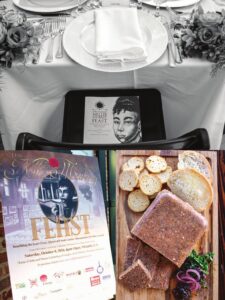
That idea blossomed into a collaboration with influential New Orleans women, including Donna Cummings and D. Joan Rhodes—both dynamic pillars of our community. Together, we planned the Nellie Murray Feast for October 8, 2016.
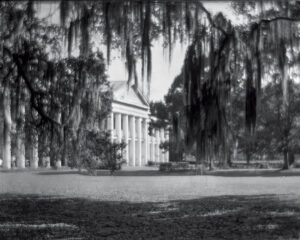
An aging plantation in Bayou Goula, near where Nellie A. Murray was born.
The six-course dinner featured Chef Edgar “Dook” Chase IV, grandson of Leah Chase, along with a collective of New Orleans culinary icons and visiting chefs. They prepared long-lost Creole dishes, including two that Nellie Murray was once renowned for: daube glacé and an oyster gumbo, lovingly re-created by Ms. Linda Green, the “Yakamein Lady.”
The feast not only honored Leah Chase and raised funds for the documentary, but also paid homage to her forerunner, the legendary Nellie Murray.
I truly believe that the departed souls of New Orleans are never really gone. To live and die in New Orleans is unlike anywhere else in America—we remember our ancestors. For me, it felt as though Nellie Murray found me, and I had no choice but to tell her story.
“Do you know Nellie Murray? To admit that you do not is a confession that you are not a member of the New Orleans Four Hundred.” (the Daily Picayune, March 8, 1894)
Born enslaved in 1835 to the family of Louisiana Governor Paul Octave Hébert in Bayou Goula, Nellie Murray was raised in a lineage of culinary excellence. Her mother, grandmother, and sister ran the kitchen at the governor’s estate, preparing elegant meals for every déjeuner, soirée, ball, and feast. They cooked with precision and polish—gleaming china, sparkling stemware, hand-ironed linens—and with every dish, young Nellie absorbed their generational skills.
Slavery’s dark shadow did not define Nellie. After emancipation, Nellie continued to work for the Hébert family in their New Orleans home. But eventually, she launched her own catering business—one of the most successful of her time. Her clientele spanned the elite of New Orleans, New York, Chicago, Paris, Vienna, London, and beyond. By the end of the 19th century, Nellie Murray was regarded as the most celebrated caterer in New Orleans.
Through the Nellie Murray Feast, I was able to pay tribute to the 19th-century Queen of Creole Cuisine while also honoring our 21st-century Queen, Leah Chase. For the 2016 Nellie Murray Feast, I wrote a dramatic script that was performed by the acclaimed New Orleans actress Karen Livers, with a stirring performance by OperaCréole. The script was based on documented articles and national publications I uncovered during my research.
Her name was Nellie A. Murray and she was the Queen of Creole Cuisine.
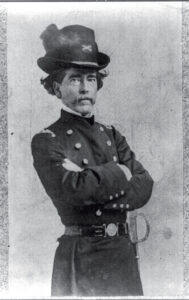
Paul Octave Hébert, 14th governor of Louisiana
BONNE SOIRÉE, MON CHER AMI!
My name is Nellie A. Murray. C’est un plaisir de vous rencontrer. I was born in 1835 in Bayou Goula, Louisiana. My grandmother, mother, and sister were all enslaved during the height of the antebellum period. For generations, we prepared some of the finest meals with unmatched care and precision.
We served one of the most prominent families in Iberville Parish and New Orleans—the Hébert family. Monsieur Paul Octave Hébert became the 14th governor of Louisiana in 1853. I was just 18 years old when he assumed office. From my earliest days, I learned the secrets of Creole cuisine from ma mère and ma grand-mère.
I still wonder how they managed to prepare such magnificent meals over open fireplaces for the governor and his guests. Ma mère could have made an epicure of ancient Rome crown her with laurels. I will never forget her daube glacé—it simmered for hours until it cut like cream.
By the end of the Civil War, I was freed by de facto. In my early 30s, I moved to New Orleans with the Hébert family. My years cooking alongside ma mère had prepared me for a journey that would take me around the world and into the company of remarkable people.
In New Orleans, I worked with Mrs. Thomas Miller, a refined woman who entertained often. It was during this time I honed the art of hosting. Many women, seeing my passion, were generous with their guidance. Of course, I carried everything I had learned from ma mère, but New Orleans opened the door for me to become the most sought-after caterer in high society.
Though I had learned hairdressing, I returned to the kitchen when I began cooking for Mrs. Frank T. Howard and her daughter, Annie. Soon, I was booked every day of the year. I bought a home on Delachaise Street and shared it with my dear friend and modiste, Marie Alexander. I was always dressed in haute couture—my fabrics came directly from Paris.
I am still grateful to the Daily Picayune for their kind words they said about me in 1894:
“To know her is to argue oneself unknown. She is the queen of her art, for art it is—her thorough knowledge of what constitutes an elegant menu, a beautifully decorated table, and her ability to prepare and arrange either . . . Nellie is an aristocrat, for all that her skin is dark.”
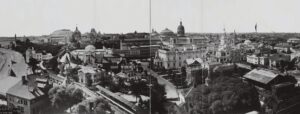
Scenic vista from the 1893 World’s Fair in Chicago, Illinois, where Nellie cooked at the Louisiana Mansion Club.
Mon Dieu, mon cher ami, they even wrote about my first European voyage with Miss Annie Howard. Quel voyage!
Our journey began in England. Now, the English don’t serve coffee like we do in Louisiana—but they do know how to serve tea, and with elegance. So many butlers just to pour a cup!
In Germany, the cooking is good, though very much in the German style. Their bread is excellent. In Austria, the cuisine is tolerable, but they don’t cook for the soul.
But Paris—ah, Paris! Just the memory of its kitchens makes my mouth water. I saw New Orleans in Paris. There, people truly know how to live. We lived royally. There is no place in the world outside of Paris where people know how to cook—except New Orleans.
At one affair, a gentleman I knew from New Orleans said to me, en passant, “Nellie, this is all very fine, but I have never eaten anything better than what the old Creole cooks made in my kitchen in New Orleans. I would place you beside any Parisian cook.”
I watched closely in Paris and learned to make filets de sole. There is no sole in New Orleans, but flounder is similar. When I returned to New Orleans, I made sole à la cardinale for many of my clientele.
In England, people regarded me as something extraordinary. Perhaps it was my dark skin—they thought I was from India. In Paris, people stared and ladies would ask, “Where did that East Indian woman learn to speak such fine French?” I always replied, in perfect French, “In New Orleans.”
Though Miss Annie and Mr. Parrott were good to me, there is no place like home. I had to return.
Though I adored traveling with my ladies, the greatest honor of my life came during the 1893 World’s Fair. I was invited to be chef de cuisine for the Louisiana Mansion Club at a salary of $150 per month. Imagine that! I was the talk of the fair. The lines were around the corner. Every dish I served was a taste of home—New Orleans by way of Nellie Murray.
Before the fair ended, I had to resign—I was exhausted. But I stayed in Chicago a bit longer to cater private events for prominent individuals. Still, I always came home—to Nouvelle-Orléans.
My calendar was filled with clubs, balls, cotillions, Mardi Gras celebrations, weddings, luncheons, and charity events. Once, I made 1,030 sandwiches and the finest drip coffee for soldiers shipping off to Cuba.
Though New Orleans society adored me, I still had to ride behind a screen on the streetcars. I wrote to the newspaper to voice my outrage at such an unjust law.
I was always selective about my clients. I cooked for the Stauffers and the Whitneys. In 1903, I even catered a luncheon for Susan B. Anthony’s suffrage convention when she visited New Orleans.
For half a century, I was “in society.” New York and Washington would send for me: “Dear Nellie, make no engagements—we want you.”
In 1918, I passed away at 83 years old. I was once enslaved, yet I became a free woman and I amassed a fortune. I worked for some of the wealthiest and most prestigious families in New Orleans and across the globe. The Daily Picayune once wrote about me:
“All of the fashionable—or nearly all of the fashionable—functions given in New Orleans are not considered complete without the assistance of Nellie Murray, whose deft fingers fashion many of the dainty dishes that delight both the eye and palate during the gay season.” I AM Nellie A. Murray.
Nellie A. Murray was recognized as part of a tricentennial series that celebrated 300 New Orleanians who contributed to modern day New Orleans. In 2018, a portrait of Nellie Murray was made by Where Y’Art artist Jessica Strahan.