Text: Caitlin Watzke
New Orleans’ obsession with coffee is no secret. From the traditional café au lait at Café du Monde to the flaming Café Brûlot at Arnaud’s and brews from the dozens of third-wave micro-roasters that have cropped up in recent years, there is no shortage of great coffee in the Crescent City. Ask any java-loving New Orleanian what makes the city’s coffee so special, and they’ll tell you it all comes down to chicory, the bitter root of the endive plant, which is roasted, ground, and blended with dark-roast coffee for a distinct taste that many New Orleans natives have come to favor.
Coffee itself has maintained a presence in the city since the 1700s. By the 19th century, New Orleans grew to become the second-largest port in the country. Over the years, the city grew into one of the country’s premier coffee-handling ports. In fact, according to the Port of New Orleans, 250,000 tons of coffee beans currently move through the port each year. That’s enough to brew 20 billion cups of coffee.
Exactly when chicory was first utilized as an addition or substitution to coffee is unclear, but it was cultivated as early as 5,000 years ago by the ancient Egyptians, who used it for its supposed medicinal qualities. It is thought that chicory may have caught on as a coffee substitute in France a few centuries ago as a way to stretch coffee during times of hardship.
It is uncertain when the practice was first embraced in New Orleans, but some sources say it came to the area by way of the Acadians, who had been using it as a digestive aid and brought it with them following their expulsion from Nova Scotia in the 18th century. Some say chicory gained favorability during the Civil War, when coffee was in short supply due to the Union naval blockades that cut off the Port of New Orleans.
No matter chicory’s origin here, New Orleanians eventually developed a passion for its unique taste, and many local coffee drinkers still prefer it this way. Geoffrey Meeker, owner of French Truck Coffee, attributes this partly to tradition but also to the flavor of the roasted chicory root.
“[Roasted chicory] brings both sweetness and viscosity to coffee, and it makes what I think is probably a superior product when it comes to iced coffee, relative to just straight-up coffee,” Geoffrey says. “That complexity and that mouthfeel addition just makes something kind of magical as far as the flavor goes.”
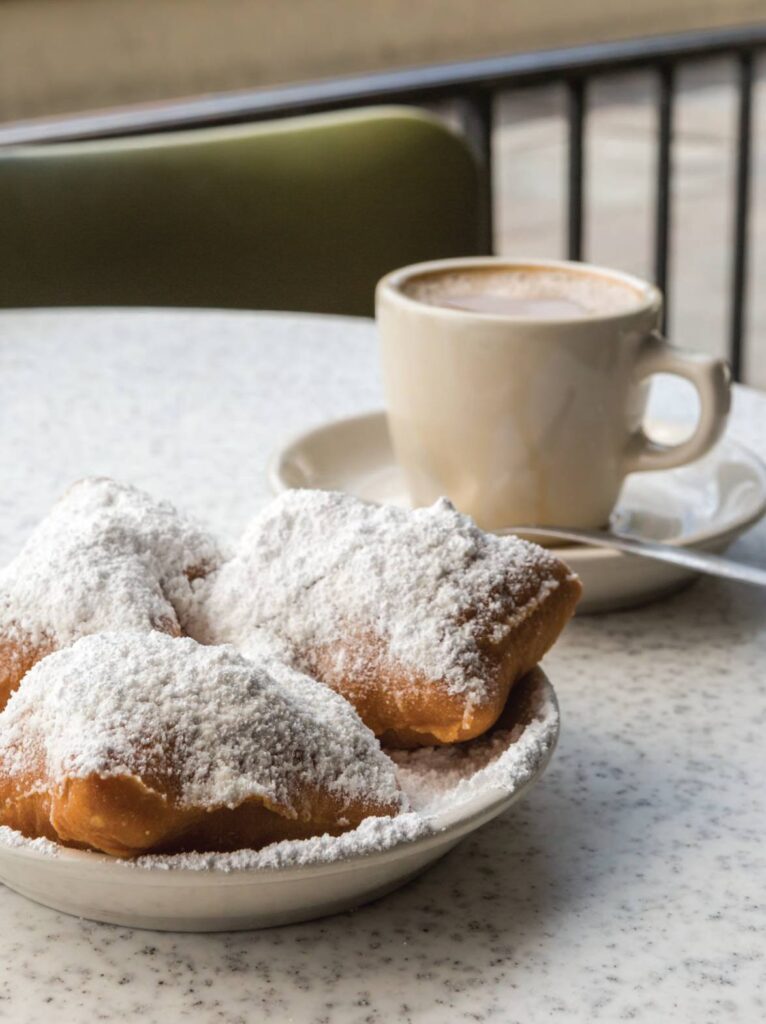
Today, chicory coffee with milk, or café au lait, is one of the most popular ways to drink it, especially alongside a pile of fresh, hot beignets. At French Truck Coffee, Geoffrey uses U.S.-grown chicory for his Nouvelle Orleans Chicory Coffee blend and bottled cold brew concentrate. Chicory blends can also be found on many grocery store shelves from companies like French Market Coffee, Café du Monde, and Community Coffee, which also sells pure chicory.
Because of New Orleans’ French roots, it was always a given that the city would have a strong coffee culture. And just as New Orleans has done with other aspects of its melting pot culture, it has made this tradition uniquely its own.
“I just think it’s a really cool quirk of history that got us to the point where it’s so common in New Orleans and so uncommon everywhere else,” Geoffrey says.
Creole Classic
Despite chicory’s mysterious origins in New Orleans, it has become a local tradition. For many New Orleanians, the best way to enjoy chicory coffee is in café au lait, or coffee with milk. Add in a few sugar-dusted beignets, like those pictured here from Café du Monde, and you’ve got yourself a real treat.